





What are the advantages of using rs485 modbus in three-phase energy meters for smart grids? | Insights by EcoNewlink
Practical, manufacturer-focused answers on why RS485 Modbus is ideal for three-phase energy meters in smart grids—covering reliability, wiring, scaling, security, register mapping, and interoperability.
- 1. How can I ensure reliable RS485 Modbus communication for three-phase meters in electrically noisy substation and feeder environments?
- 2. What are practical ways to scale RS485 Modbus networks beyond the 32-device limitation when deploying dozens or hundreds of meters?
- 3. How do I secure Modbus RTU in three-phase meter deployments given Modbus lacks built-in encryption or authentication?
- 4. How should Modbus register mapping and data formats be specified to ensure interoperability between different meters and host systems?
- 5. What practical cabling, topology and configuration choices minimize latency and maximize update rates for interval metering over RS485 Modbus?
- 6. What electrical protection and isolation specs should I require in meter hardware to meet smart grid reliability and safety expectations?
Advantages of Using RS485 Modbus in Three-Phase Energy Meters for Smart Grids
As an electrical components manufacturing and systems-integration expert, this article answers six specific, practical questions industry buyers and engineers commonly face when specifying or purchasing three-phase energy meters that use RS485 Modbus for smart grid applications. Answers reference established norms (EIA-485, Modbus protocol practices, IEC guidance) and give actionable design and procurement guidance to ensure reliable field deployments.
1. How can I ensure reliable RS485 Modbus communication for three-phase meters in electrically noisy substation and feeder environments?
Noise immunity is a top pain point for metering in substations, feeders and industrial sites. RS485 is a differential, balanced interface (EIA-485) that inherently rejects common-mode noise when implemented properly, but you must address physical-layer details:
- Wiring topology: Use a single daisy-chain (linear) backbone between devices — RS485 works best in a bus topology. Avoid stubs; any branch longer than a few centimeters can cause reflections and errors.
- Termination and biasing: Place 120-ohm termination resistors at both ends of the segment. Add bias (pull-up/pull-down) resistors at a designated master or isolated bias module to maintain defined idle line levels and prevent false addresses when no node is transmitting.
- Cable choice and routing: Use twisted-pair shielded cable rated for industrial use (e.g., 120 Ω characteristic impedance). Route data pairs away from power conductors and large switchgear; when crossing, do so at 90° angles.
- Galvanic isolation: Select energy meters with galvanic isolation between the RS485 transceiver and the meter electronics (typically 2–4 kV isolation). Isolation prevents ground loops and helps with high common-mode voltages in meter installations.
- Surge/suppression: Use common-mode surge protectors and gas discharge tubes or TVS diodes on RS485 lines where exposure to lightning or switching transients is possible. Surge protection on the power supply side is also essential.
- Proper grounding: Tie cable shields to earth at one point (usually at the master controller or a protector cabinet) to avoid creating loops that introduce noise.
Together these measures maintain reliable CRC-checked Modbus RTU frames even in noisy environments. For substations with extreme EMI, consider fiber or RS485-to-fiber converters for galvanic isolation and immunity.
2. What are practical ways to scale RS485 Modbus networks beyond the 32-device limitation when deploying dozens or hundreds of meters?
RS485 transceivers traditionally define 1 unit load and permit 32 unit loads on a bus. Modern low-unit-load (1/8 or 1/4) transceivers let you connect many more devices electrically, but best practice for large meter deployments is to segment the network for reliability and manageability.
- Segmenting with repeaters/gateways: Use RS485 repeaters or intelligent Modbus gateways to split the network into multiple electrically independent segments. This prevents a single fault from taking down hundreds of meters.
- RS485-to-MODBUS-TCP (Ethernet) gateways: Deploy local gateways to convert Modbus RTU to Modbus TCP. Gateways allow aggregation of many RTU segments and integration into SCADA/MDMS over Ethernet or cellular networks.
- Use multi-drop with low unit-load transceivers: Choose meters with 1/8 unit-load transceivers to increase on-bus device counts when segmentation is not practical—but maintain termination and biasing.
- Logical partitioning and addressing: Plan Modbus addressing carefully (avoid address clashes) and keep short polling cycles per segment to reduce latency. For very large installations, combine hierarchical polling (local concentrators) with aggregated reporting rather than polling each meter directly from a central master.
Architecting with repeaters/gateways provides the best trade-off of scale, fault tolerance, and maintainability. This approach is common in AMI and SCADA rollouts.
3. How do I secure Modbus RTU in three-phase meter deployments given Modbus lacks built-in encryption or authentication?
Modbus RTU is simple and deterministic but does not include encryption, authentication, or replay protection. For grid-grade deployments, implement layered security measures:
- Network segmentation: Place meter RS485 networks inside a protected OT segment with strict firewall rules. Do not expose RTU segments directly to enterprise networks.
- Use secure gateways: Terminate Modbus RTU at an encrypted gateway that supports VPNs, TLS (for TCP), and modern authentication before data reaches corporate/utility networks or cloud systems.
- Device hardening: Disable unused services on gateways and masters; change default passwords; use role-based access control for configuration interfaces.
- Message integrity: Where possible, use gateways that implement message signing or integrate with OPC UA or IEC 61850 over secure transports—these protocols have stronger security models than plain Modbus RTU.
- Monitoring and IDS: Deploy intrusion detection and logging on OT networks. Monitor Modbus traffic anomalies such as unusual polling rates or unexpected function codes.
- Physical security: Lock cabinets and protect access to meter heads and communication ports to deter tampering.
For procurement, require meter vendors to document how the device fits into secure gateway architectures, and ask for third-party validation (e.g., IEC 62443-compliant components or security-tested gateways).
4. How should Modbus register mapping and data formats be specified to ensure interoperability between different meters and host systems?
Interoperability often fails not because of RS485 or Modbus, but because of inconsistent register maps, scaling, and data types. To avoid integration delays, specify these items clearly in purchase documents:
- Standard register definitions: Use industry-accepted register maps where available (many meter manufacturers follow de-facto energy register maps). For commercial/utility deployments, request a clear Modbus register map covering instantaneous values, cumulative energy (kWh/kVARh), per-phase voltages and currents, frequency, power factor, and alarms.
- Data types and endianness: Require explicit definitions for 16-bit vs 32-bit registers, use of IEEE 754 floating-point for values (if used), and byte/word order (big-endian or little-endian). Provide example Modbus frames for common reads.
- Scaling factors: Define fixed-point scaling in the map (e.g., volts stored as 0.1 V units or as float). Avoid ambiguous “scale-by-register” schemes unless both sides implement it identically.
- Use of function codes: Standardize on function codes (e.g., 03 Read Holding Registers, 04 Read Input Registers, 16 Preset Multiple Registers for writes) and specify permitted write operations (tariff settings, clocks, resets) and safety/auth controls required to perform them.
- Time-stamped data: If interval or time-of-use data are required, require meters to implement real-time clocks (with battery backup) and provide timestamped logs or event registers. Note that Modbus RTU does not standardize time sync — plan on using an out-of-band time sync mechanism (NTP via gateway or IEC 61850/IEC 60870-5-104 in higher-end systems).
During factory acceptance testing (FAT), exchange sample Modbus frames and perform conformance tests with the intended MDMS/SCADA to confirm correct mapping, byte order, and scaling before field shipment.
5. What practical cabling, topology and configuration choices minimize latency and maximize update rates for interval metering over RS485 Modbus?
RS485 Modbus RTU is polled master-slave; update rate depends on segment baud rate, number of devices, frame sizes and processing delay. For near-real-time applications, optimize at multiple levels:
- Baud rate vs distance: Select the highest reliable baud rate given cable length and noise. Typical choices are 9,600–115,200 bps — higher speeds shorten frame times but reduce allowable cable lengths. For runs up to ~1.2 km, lower baud rates are safer; for short runs, 115.2 kbps gives faster polling.
- Frame size optimization: Read only required registers in grouped blocks to minimize overhead. Reading many small frames increases inter-frame delays and slave turnaround time.
- Segmenting and local aggregation: Use local concentrators/gateways that poll dozens of meters quickly and forward aggregated data at lower rates to the head-end. This reduces master poll load and improves responsiveness for local control.
- Modbus RTU timing: Respect inter-frame and inter-character timing (3.5 char times between frames) to avoid frame collisions. Modern masters/gateways manage this automatically, but custom masters must implement proper timing.
- Device processing time: Specify meter response times in procurement (e.g., maximum response latency per Modbus request). Choose meters with fast CPUs and optimized firmware if tight update windows are required.
Example: Polling 50 meters at 19.2 kbps for a 10-register read per meter can be achieved with sub-second aggregate cycles if frames are packed efficiently and segments are split sensibly; however, design conservatively and test with real firmware/hardware.
6. What electrical protection and isolation specs should I require in meter hardware to meet smart grid reliability and safety expectations?
Buyers must specify isolation, surge protection and EMC performance for meters installed on medium- and low-voltage networks. Typical, practical requirements to include in specifications:
- Galvanic isolation: RS485 transceiver isolation of 2.5–4 kV galvanic isolation between communication ports and meter power/measurement circuits is standard in many grid meters. Also require isolation between power supply and measurement circuitry per application needs.
- Common-mode voltage tolerance: Communication ports and measurement inputs should tolerate expected common-mode voltages and transients present on distribution networks; consult local utility standards for required withstand levels (e.g., LV distribution vs HV feeders).
- Surge protection: Include IEC 61000-4-5 surge immunity levels and specify surge protective components on communication and power lines for outdoor/feeder installations. Gas discharge tubes and coordinated SPD designs are common for RS485 lines in exposed environments.
- EMC/EMI compliance: Require IEC 61000 series compliance (emission and immunity) appropriate to the installation class, e.g., IEC 61000-4-3 for RF immunity and IEC 61000-4-8 for power frequency magnetic fields.
- Mechanical/environmental ratings: Define IP rating for enclosures (IP54–IP65 depending on mounting), operating temperature range, and vibration specs for pole or cabinet mounting.
When sourcing meters, ask for lab test reports and certificates (third-party IEC test reports where available). For utility-grade procurements, include mandatory compliance with relevant local/regional standards and provide sample hardware for laboratory verification.
Concluding summary
RS485 combined with Modbus RTU remains a practical, cost-effective, and interoperable choice for three-phase energy meters in smart grid contexts. Key advantages are robust differential signaling and noise immunity, long-distance and multi-drop capability, wide ecosystem and SCADA/MDMS compatibility, low component cost and straightforward integration via Modbus-to-TCP gateways. To realize these benefits in factory and field deployments, manufacturers and buyers must specify proper cabling/topology, termination and biasing, scaling/Modbus register conventions, galvanic isolation and surge protection, and a layered security architecture using secure gateways. Proper segmentation, testing, and conformance checks during procurement ensure reliable, scalable meter networks ready for smart grid operations.
For procurement support, detailed Modbus register templates, or a bespoke quote for production meters and RS485-enabled designs, contact us at www.econewlink.com or email nali@newlink.ltd.
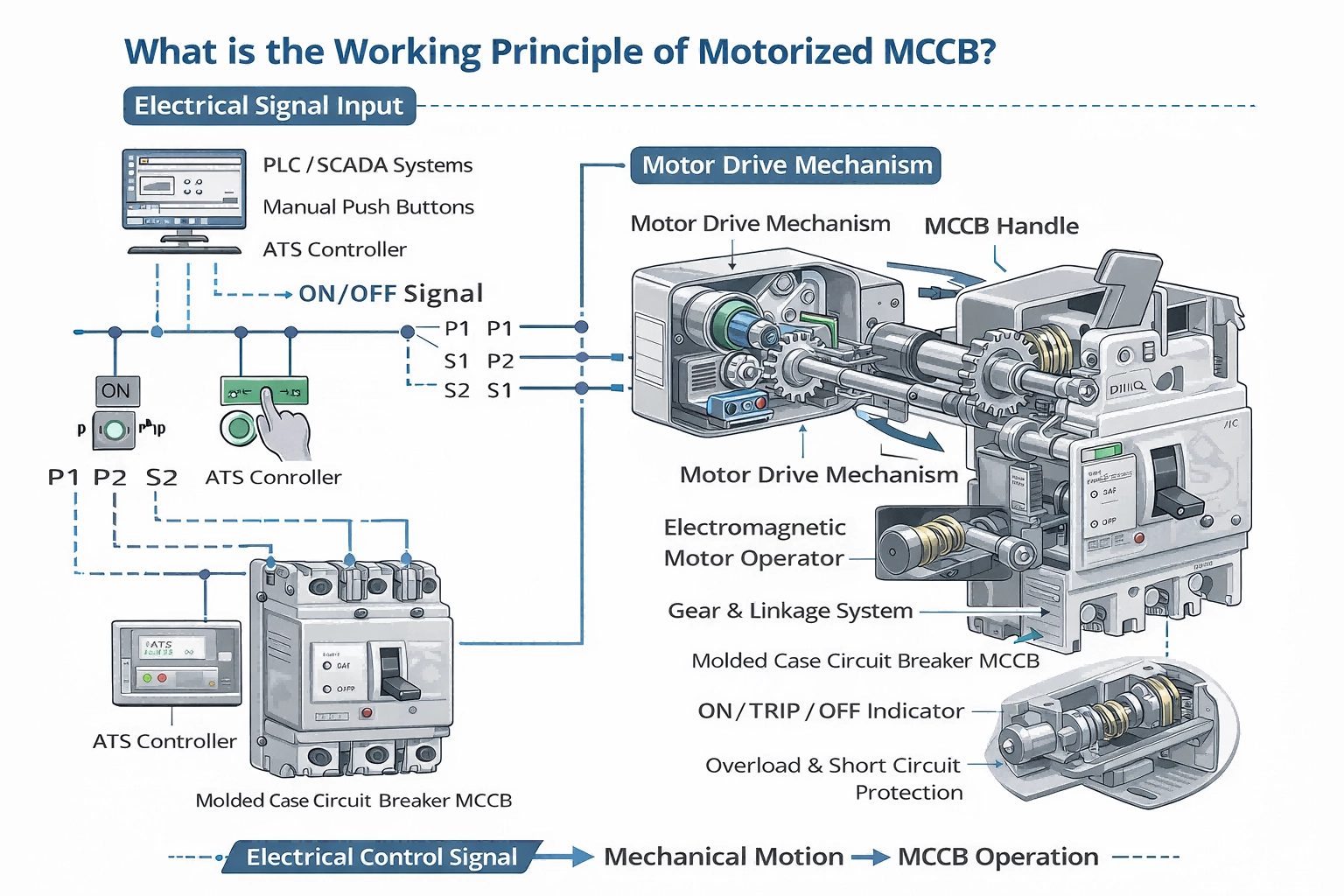
How to Use a Motorized MCCB Circuit Breaker for Remote Control and ATS Systems

30-Day DIY Electrical Panel Cost-Saving Guide – Day 3

30-Day DIY Electrical Panel Cost-Saving Guide – Day 2

How to Build Your Own Electrical Panel and Save Up to 60% on Costs
Current Transformer(CT)
Is secondary grounding required during installation?
Yes. One side of the secondary winding must be reliably grounded to ensure safety and prevent dangerous open circuit conditions.
Three-phase power meter
How stable is the measurement data?
Industrial-grade components and high-precision technology ensure stable and reliable long-term data performance.
Are OEM/ODM services available?
Yes, factory-direct OEM and ODM services are available for branding and functional customization.
Three-phase multifunction guide rail meter
Does the meter have pulse output?
Yes, it provides electrical energy pulse output.
NH series fuses
What materials are used for the fuse element?
The fuse element is made from high-purity copper or silver alloy, ensuring accurate melting characteristics and fast, reliable interruption during overload or short-circuit faults.
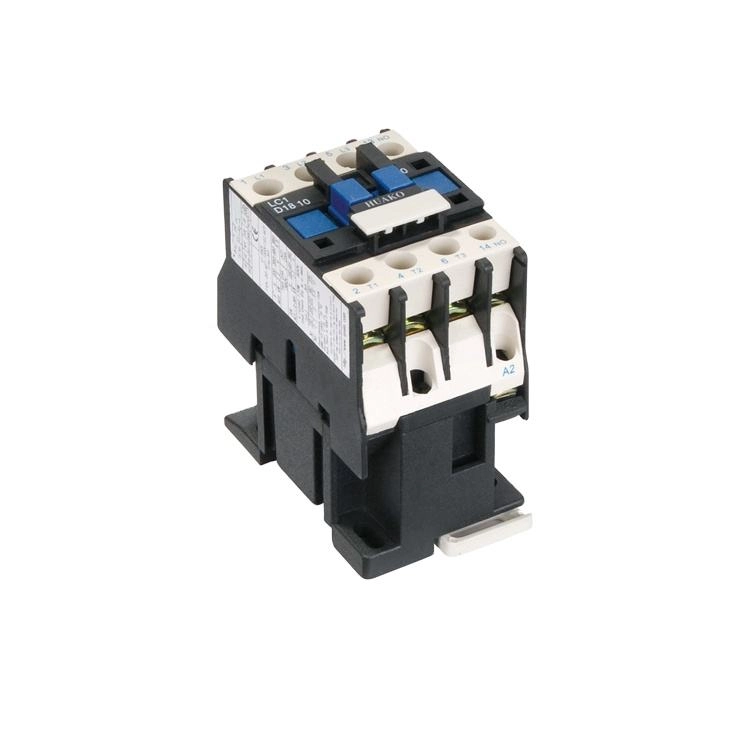
LC1 (CJX2) 220V Single Pole 2 Pole 3P 4 Pole Electrical Contactor Magnetic AC DP Definite Purpose Contactor
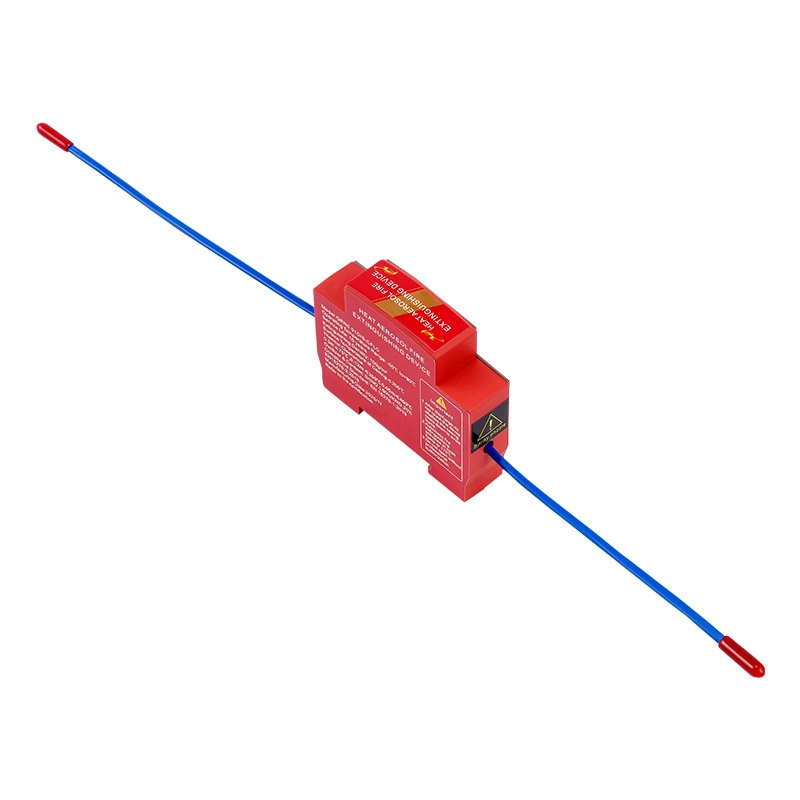
Distribution cabinet fire protection fire-fighting
Heat Aerosol FireExtinguishing Device
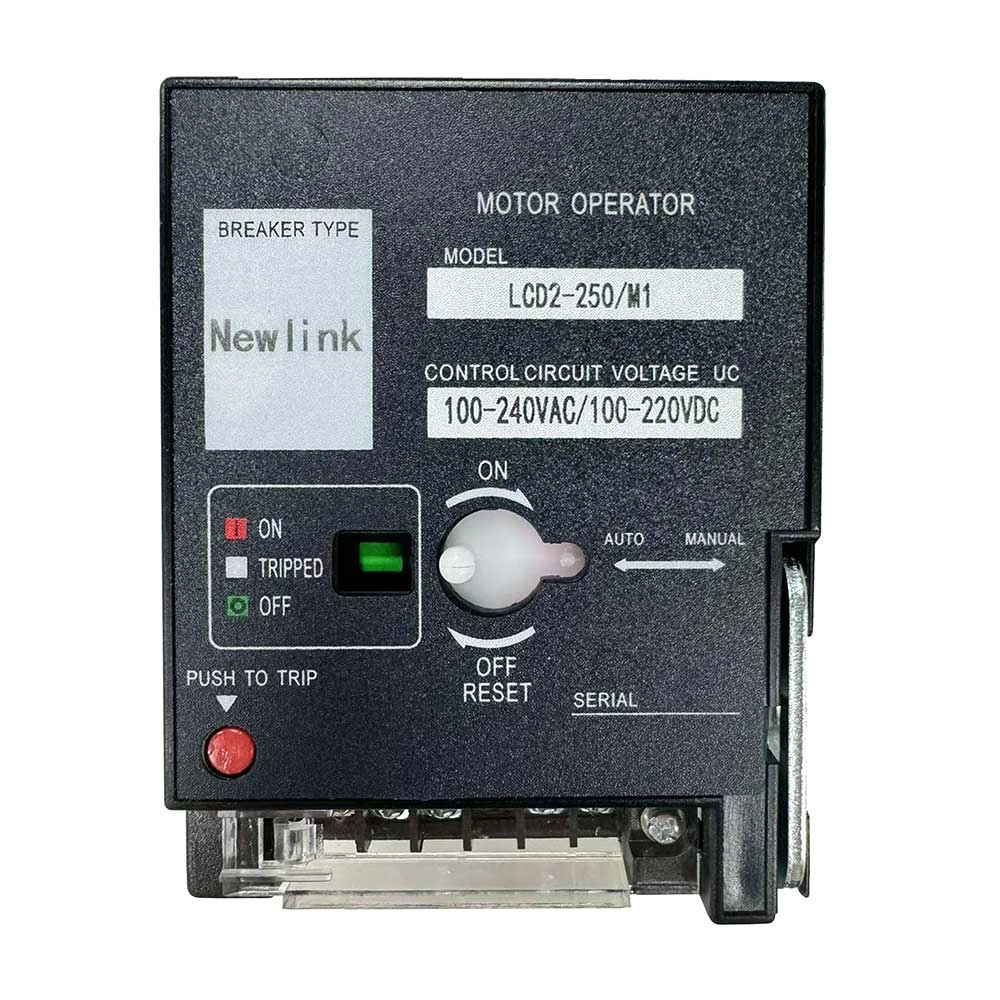
LCD2 Series Motorized Operating MCCB | Remote Control Motor Operator Molded Case Circuit Breaker | 100-240VAC/100-220VDC | Smart Power Distribution |
Motorized MCCB with remote open/close function for intelligent power distribution. Supports automatic/manual switching, control voltage 100-240VAC/100-220VDC, and reliable protection for industrial cabinets and low-voltage systems
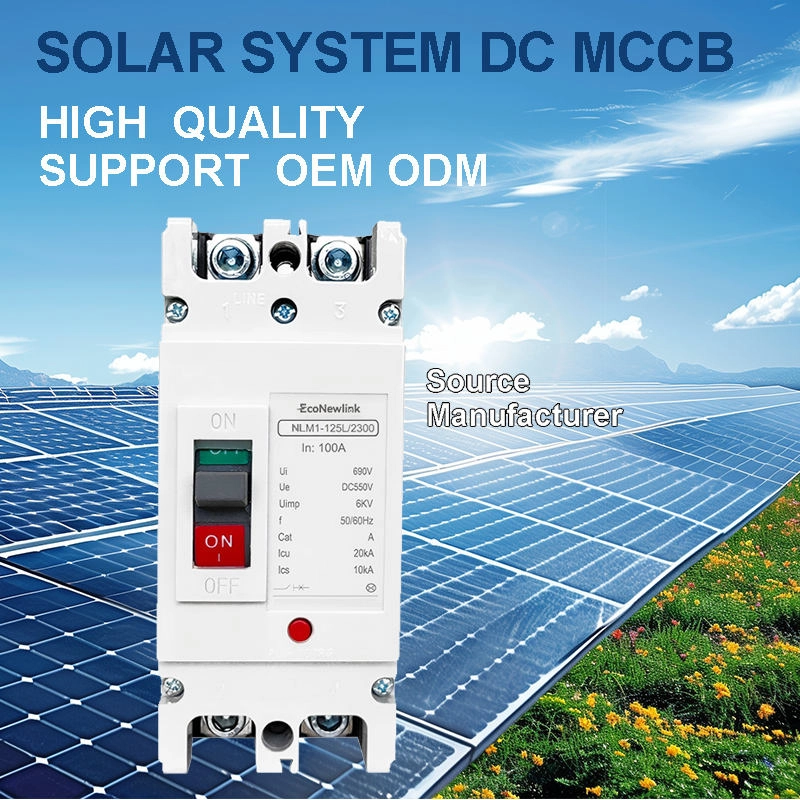
EcoNewlink DC MCCB NLM1Z 250 200A 48V Waterproof Electronic Trip 25kA Breaking Capacity
The EcoNewlink DC MCCB NLM1Z 250 200A 48V is a high-performance miniature circuit breaker designed for reliable low-voltage DC protection. Featuring a 25kA breaking capacity and waterproof design, it ensures safe and stable operation in harsh environments, including industrial systems, solar power installations, and energy storage solutions. With electronic trip technology, this MCCB delivers precise overload and short-circuit protection, combining durability, efficiency, and ease of integration for OEM and custom power distribution applications.
Request More Information or Subscribe for Updates
Thank you for reading our article!
If you would like more detailed information, have specific questions, or want to stay updated with the latest articles and guides, please fill out the form below.
Our team will get back to you with tailored information and resources.
Powering the Future with Smart, Safe Solutions
EcoNewlink delivers cutting-edge intelligent power products and solutions to ensure safety, efficiency, and reliability in your power distribution systems.
Contact
Email: nali@newlink.ltd
WhatsApp:
Address: No.76 Chuangyu road, Zengcheng District, Guangzhou, China

 WhatsApp
EcoNewlink
EcoNewlink